GreenPoint Rated New Home Version 10: Building for Resilience, Value, and the Future

Program Update Version 10

Built with the Field in Mind

Version 10 was developed through extensive dialogue with raters, industry experts, and jurisdictions, informed by real-world application and feedback from the field. The checklist is intended to be used early as a planning and decision-making tool during pre-construction and design, when it can most effectively support cost-effective strategies and reduce downstream risk.

By emphasizing resilience, performance, and durability, Version 10 helps project teams support long-term outcomes that matter to owners and communities alike, including lower operating and maintenance costs, fewer disruptions over time, and healthier, more comfortable spaces for residents and occupants.

Key takeaway

Resilience, performance, and durability reduce downstream risk and support long-term value.
 

Program Update•Version 10
 

What’s New in Version 10

New Category: Resilience

Version 10 introduces Resilience as a standalone category, elevating the importance of designing buildings that remain safe, functional, and livable as climate risks increase. The Resilience category addresses hazards such as wildfire, flooding, extreme heat, and power outages, with a focus on preparedness, durability, and recovery.

Graphic illustrating the new Resilience category in GreenPoint Rated Version 10
Resilience is introduced as a standalone category in Version 10.

As part of this update, projects are required to complete a Climate Vulnerability Assessment. This screening-level exercise is intended to help teams identify relevant risks and inform early design decisions; it does not mandate specific design responses and can be completed with minimal additional effort when integrated early in the project process.

Key takeaway

Version 10 elevates resilience planning through a required Climate Vulnerability Assessment that supports early, integrated decision-making without mandating specific design responses.

Category Refresh in Version 10

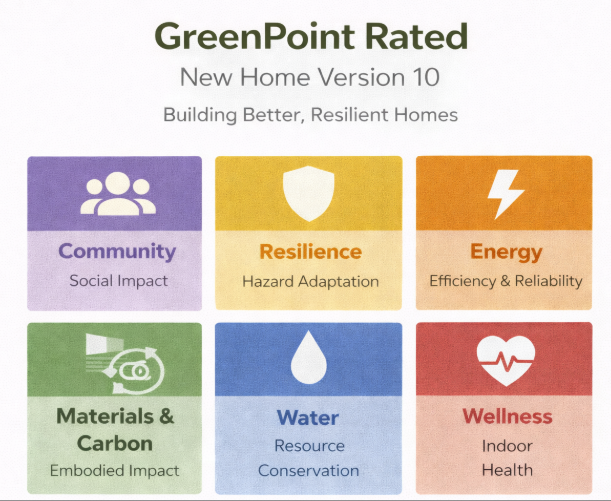
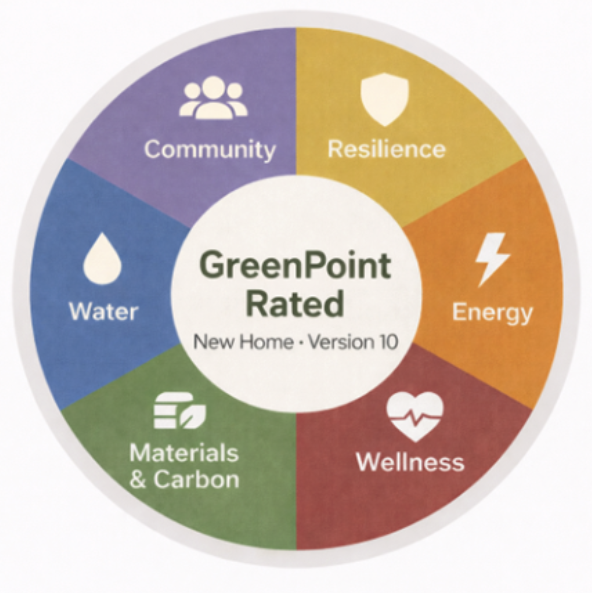
Version 10 refreshes and clarifies all six GreenPoint Rated categories—Community, Resilience, Energy, Wellness, Materials & Carbon, and Water—to better reflect whole-building performance and long-term outcomes.

While the overall structure of the program remains familiar, these updates place greater emphasis on durability, risk mitigation, and life-cycle thinking. The checklist remains flexible and achievable—particularly when used early to guide integrated design decisions and support real-world value over the life of the building.

Program Update Version 10

Point Redistribution & Achievability

Version 10 redistributes the minimum point requirements across all six categories to better reflect the importance of resilience, energy performance, materials impacts, and occupant health in long-term building outcomes.

While Version 10 redistributes points across categories, it is not intended to increase overall effort or make certification harder to achieve; rather, it shifts focus toward measures that are already familiar, practical to implement, and more closely tied to long-term building performance.

Program Update Version 10

Energy Updates

Version 10 updates how energy performance is recognized in response to California’s increasingly stringent energy code baseline and recent policy changes. Rather than relying on automatic points for meeting Title 24, the updated framework shifts emphasis toward strategies that deliver meaningful decarbonization, grid flexibility, and long-term reliability.

Graphic illustrating Version 10 Energy Updates
Version 10 updates how energy performance is recognized.

Energy remains the category with the most points available overall. New and expanded measures reward projects for reducing grid demand, supporting load shifting, and maximizing the value of on-site energy resources, many of which also strengthen resilience by improving reliability during outages and reducing dependence on vulnerable infrastructure.

Key takeaway

Version 10 moves beyond baseline compliance to prioritize energy strategies that deliver decarbonization, grid flexibility, and long-term reliability.

This shift reflects a move from incremental efficiency gains toward achievable, integrated strategies that deliver real-world climate, cost, and resilience benefits over the life of the building, while keeping energy central to GreenPoint Rated and aligned with California’s policy direction.

In the coming weeks, we will publish additional cost-effectiveness analysis and use it to finalize calibration of select energy point thresholds across California’s climate zones. Version 10 will be updated as needed to reflect this final calibration, and we will notify the rater community of any resulting updates.

Program Update Version 10

What This Means for Project Teams

Taken together, Version 10 is intended to support earlier, more constructive conversations between raters, project teams, and owners—helping reduce redesign risk, improve long-term performance, and deliver buildings that are healthier, more resilient, and better aligned with real-world expectations.


Program Resources•Version 10
 

More Information

Additional details and working documents can be found here as well as in the Rater Portal:

Additional supporting materials, including an updated technical manual, a full Data Collection Form (DCF), and supporting guidance, will be released in the coming weeks.

Program Events • Version 10
 

Rater Webinar

To support raters and project teams as Version 10 rolls out, we will be hosting a webinar reviewing the changes under New Home Version 10 and a follow-up open office hour the week following. These sessions will provide an overview of the key updates as well as an opportunity to ask questions and discuss how Version 10 applies to real projects.

Rater Webinar: Introduction to New Home Version 10
Monday, January 26 · 2:00 – 3:30 PM PST

Register

Open Office Hour
Wednesday, February 4 · 11:00 AM – 12:00 PM PST

Register